What is OCPP 2.0.1?
Open Charge Point Protocol 2.0.1Reviewed
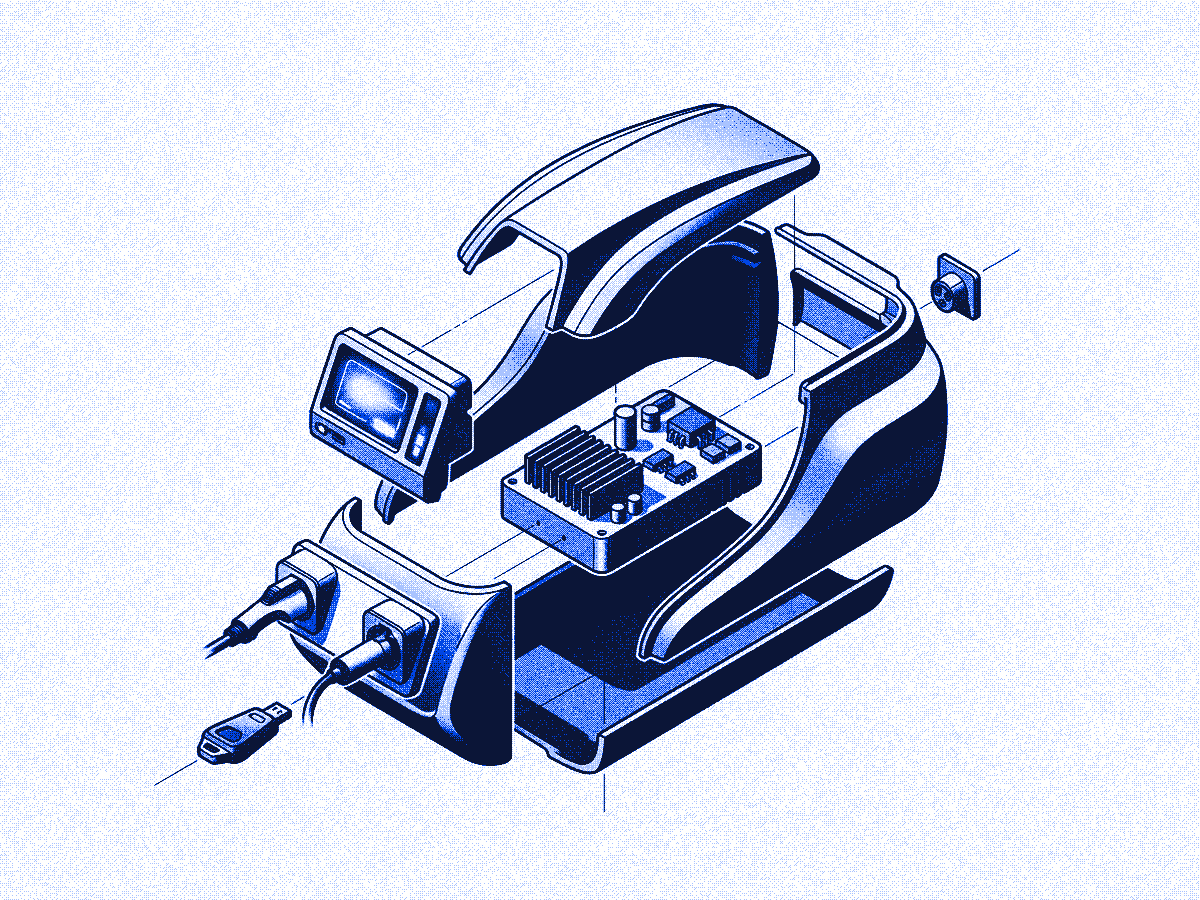
OCPP 2.0.1 is the 2020 version of the Open Charge Point Protocol, the Open Charge Alliance standard for communication between EV chargers and the software that manages them. It replaces OCPP 1.6’s flat configuration with a structured device model, builds security into the protocol, supports ISO 15118 Plug & Charge and reports every session as a stream of transaction events.
- Published byOpen Charge Alliance (OCA)
- Released2020
- TransportJSON over WebSocket
- Compatible with 1.6No: a separate protocol version
- Next versionOCPP 2.1 (2025)
01
What OCPP 2.0.1 does
OCPP 2.0.1 does the same core job as 1.6, connecting a charging station to a charging station management system (CSMS) for sessions, authorization, metering and remote control, but it describes the station in far more detail and secures the link by design.
It also adds functions operators had been building as vendor extensions: showing messages and prices on the charger’s display, sending cost information to drivers, managing certificates for Plug & Charge, and reporting the state of each component of the station.
Key functions
- Device model of station, EVSE and connector
- Read and set any component variable
- Security profiles with TLS and client certificates
- TransactionEvent messages for the whole session
- ISO 15118 certificate handling for Plug & Charge
- Smart charging with limits from the vehicle and the grid
02
Why OCPP 2.0.1 matters
Version 2.0.1 fixes problems operators hit at scale with 1.6: inconsistent configuration across vendors, security left to each deployment, and session records split across several message types. A network on 2.0.1 can diagnose a station remotely down to the failing component.
It is also the base for what comes next. Plug & Charge needs its certificate messages, and OCPP 2.1, published in 2025 for bidirectional charging and distributed energy control, builds on 2.0.1 rather than on 1.6.
03
How OCPP 2.0.1 works
The station connects to the CSMS over a WebSocket, as in 1.6J, but negotiates the ocpp2.0.1 subprotocol and one of three security profiles: basic authentication without TLS, meant only for closed networks; basic authentication over TLS; or TLS with client certificates on both sides. Messages keep the JSON call and result structure.
A station is modelled as a charging station containing EVSEs, each with one or more connectors, and every part is a component with variables. The CSMS reads the model with GetBaseReport and changes it with SetVariables. A session is a single transaction reported through TransactionEvent messages, Started, Updated and Ended, rather than separate start, stop and meter messages.
01
Vehicle
ISO 15118 to the station
02
Station
Station, EVSE, connector
03
TLS WebSocket
Security profile 1–3
04
CSMS
Device model, transactions
04
How OCPP 2.0.1 feeds Voltra
Voltra runs chargers that speak OCPP 2.0.1 or 1.6J side by side in one network, with the same sessions, pricing, access and load balancing for both. A mixed fleet can move to 2.0.1 charger by charger without changing software.
Learn more
EV charging
Any charger that speaks OCPP 1.6J or 2.0.1, on one network.
Learn more
CSMS
Sessions, pricing, roaming and load balancing.
05
Frequently asked questions
OCPP 2.0 was published in 2018. Early implementations found issues, and the Open Charge Alliance replaced it with 2.0.1 in 2020. Deployments use 2.0.1, not 2.0.
No. The message set and data model are different. A CSMS that supports both talks 1.6 to some chargers and 2.0.1 to others, chosen when each charger connects.
Yes. It carries the messages a station needs to install and update ISO 15118 certificates and to authorize a vehicle by its contract certificate, so a driver can plug in and charge without a card or app.
OCPP 2.1, published by the Open Charge Alliance in 2025, extends 2.0.1 with bidirectional charging (V2X), control of distributed energy resources, local cost calculation and other additions, while staying compatible with 2.0.1.
Yes. In October 2024 the IEC published OCPP 2.0.1 as international standard IEC 63584, and OCPP 2.1 has since been added to the same series.