From July through September we built more than in any quarter before it. Here is what came out of it, and what's coming in October.
Q3 was a quarter of building. From July through September we put more work into the Voltra platform than in any quarter before it, and September was our biggest month yet.
Most of that work went into new products. Fabric launched in July. Energy Insights opened its public beta in September. And this week, at the NECA Convention in Las Vegas, we introduced the Voltra Load Controller with our hardware partner, PSP Products. Alongside the new products, a steady stream of improvements reached the products our customers already run every day.
Introducing the Voltra Load Controller, with PSP Products
Plenty of commercial and multifamily EV projects run into the same wall: the panel or the service can't support every charger at full output at the same time. The usual answers are a service upgrade, fewer chargers, or load shedding.
Load shedding works, but in many configurations it means a load shedding device for every charger on the site, each one wired and commissioned on its own. That gets expensive fast, and the cost climbs with every charger you add. And because each device can only cut or restore its own charger, capacity is never shared between them.
The Voltra Load Controller changes the math. Paired with a UL-listed PSP Products load management system, it can manage up to 100 chargers on a site with just two devices. Each does the job it is best at:
- PSP holds the limit. PSP's hardware monitors the panel and sheds EV load on its own if the panel approaches its limit, with no software in the loop.
- Voltra uses the headroom. The Voltra Load Controller reads the site limit from the PSP equipment and manages charging under it over OCPP, so chargers share the available capacity in real time as vehicles come and go, instead of being cut off.
Because the protection stays in PSP's listed hardware, the limit holds even if the network or the controller is unavailable.
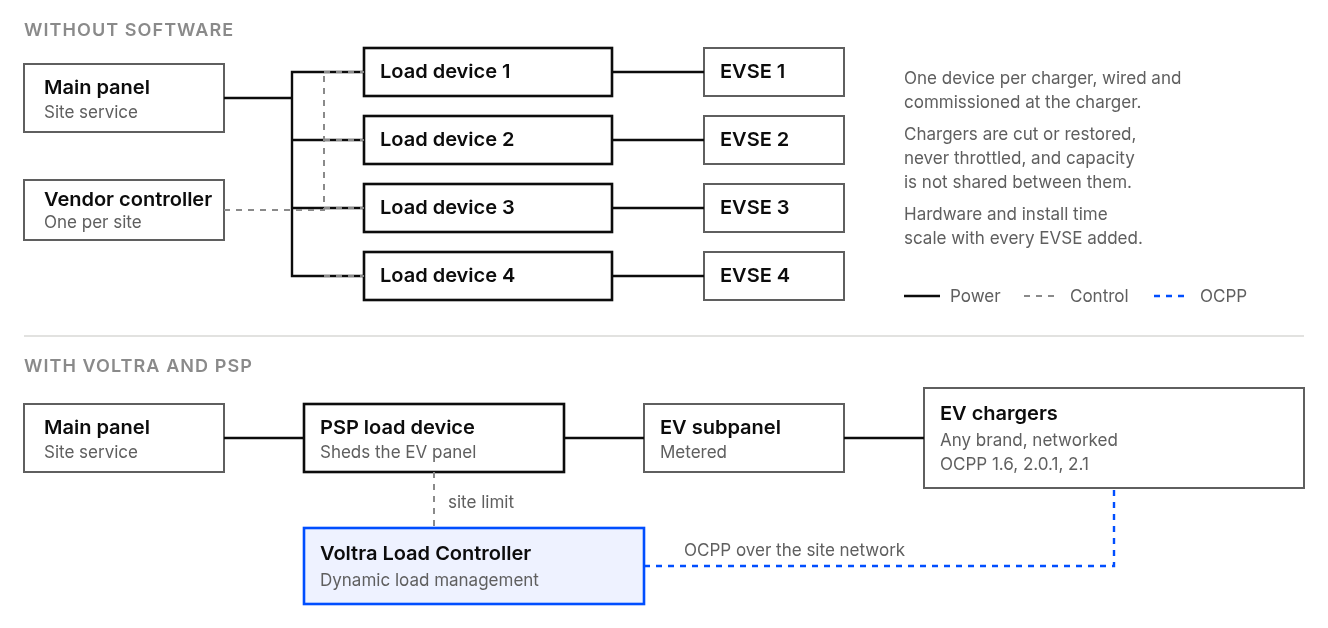
Without software, every charger gets its own load device, and hardware and install time grow with every charger. With Voltra and PSP, one PSP device and one Voltra Load Controller manage the whole EV subpanel.
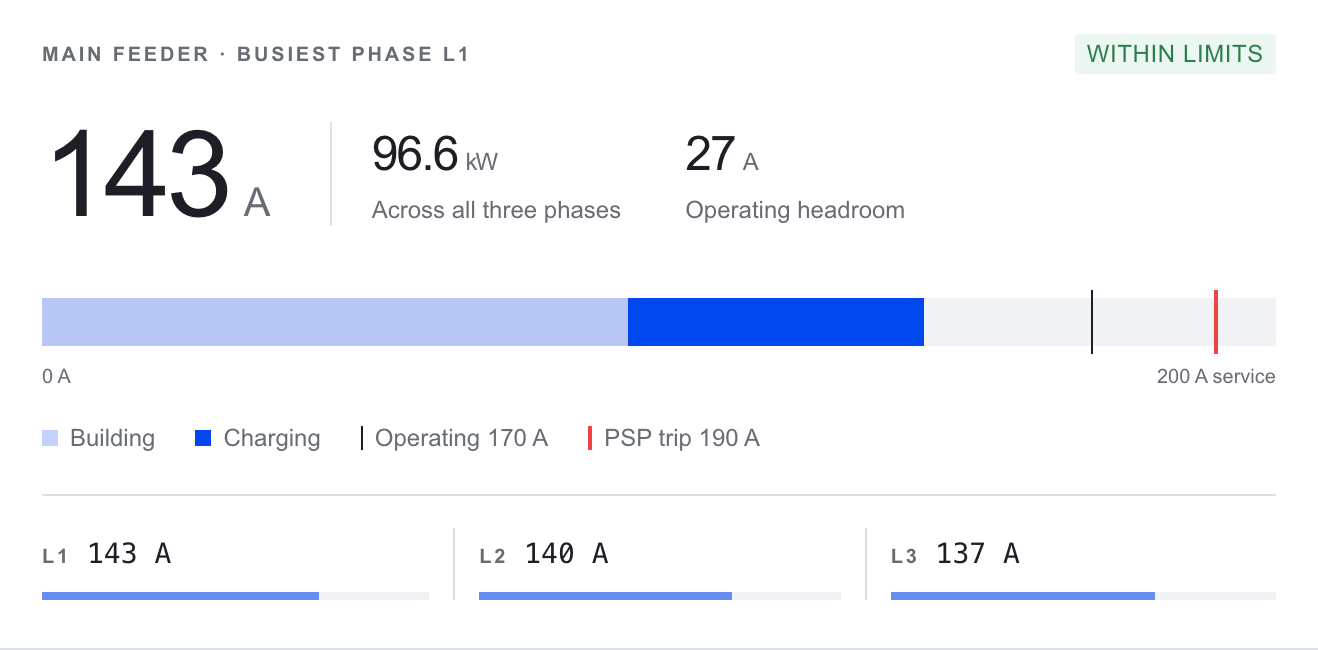
Inside the Voltra Load Controller: building load and charging load on one feeder, managed under an operating limit that sits below the PSP trip point.
For contractors, that means two devices to buy, wire, and commission instead of one per charger, more chargers on the panel a site already has, and no service upgrade. And because the controller runs on the Voltra platform, the same site can later bring in building systems, batteries, and solar when the owner is ready.
The Voltra Load Controller is offered to electrical contractors through PSP Products. Learn more about the Voltra Load Controller.
Energy Insights: from beta to live
Energy Insights helps you understand what you pay for energy, and why. It reads your utility bills, connects them to how your sites actually use energy, and uses AI to point you to where the savings are. It can also show you what solar, batteries, or demand response would be worth at a specific site, before you commit to a project.
In September we invited everyone on our newsletter to the public beta, and Energy Insights goes live more broadly later this month. If you haven't signed up yet, there's still time: voltra.com/energyinsights.
What else we built in Q3
Energy Management
- Savings you can take to your CFO. The optimizer takes its objectives directly from your site's actual utility tariff, and savings are measured against how your equipment would have run uncontrolled. Demand savings and energy savings are reported separately, so the numbers hold up.
- Connect your utility account yourself. Pick your utility, link your account, and meter data starts flowing. No integration project and no CSV emails.
- Control you can graduate into. Every site moves through a clear ladder, from off, to shadow, to supervised, to closed loop, with promotion criteria and recorded overrides at each step. Fallback policies you set decide what happens on communications loss, stale data, or an infeasible plan.
- Smarter dispatch. The optimizer now dispatches across multiple asset types under site budgets, uses live forecasts, and treats HVAC with a real thermal model, so flexibility never comes at the expense of comfort.
Charge Management
- Bring chargers online with your organization code. Point a charger at Voltra, enter your organization code, and it lands in a review queue for your team to accept. Per-charger credentials are set up automatically. As of September, this is on for every organization.
- Charger status you can trust. Online status now comes from the live connection, not a registry lookup, and in September the Console started updating charger state live as it changes.
- Stronger security and one view across versions. Charger connections support OCPP Security Profile 2, and charging analytics read the same across OCPP 1.6J and 2.0.1.
- A broader device ecosystem, including Emporia energy monitors and smart plugs.
Fabric and Platform
- Fabric launched in July, the connectivity and site model layer underneath everything we build.
- Onboard custom devices yourself. Upload a Modbus register map, preview it, and activate it against a live device, without waiting on a device profile release.
- A commissioning workbench. Browse live register values, pin and health-check the points that matter, run commissioning checks with snapshot reports, and read protocol errors in plain language.
- Health checks you define, evaluated continuously, and a site model that governs itself, with connection rules that refuse an electrical ring, a data-quality checklist, and full change history.
- Vehicle telematics from Tesla Fleet, so vehicle state of charge flows into the platform alongside everything else.
- New in September: BACnet/IP support on the Voltra edge gateway, which opens up a large share of building systems; alerts routed into the tools your team already uses (PagerDuty, Jira Service Management, Rootly, and MaintainX); and a Voltra CLI that now covers every public operation across our core services, with API references generated directly from the code so they always match what ships.
Trust and reliability
- Zero-trust inside the platform. Mutual TLS between every service, workload identity on every request, and just-in-time access for Voltra staff, with every elevation audited.
- Tighter separation between customer organizations, enforced at the data layer across our services.
- Faster detection. Monitoring and alerting are consolidated, including alerts when expected data stops arriving.
From the field: Yotta
At Yotta in Las Vegas at the end of September, conversations kept coming back to two ideas: getting more out of power capacity that already exists, and moving compute to the edge in smaller formats. Both line up with how we think about energy. Often the fastest capacity to bring online is the capacity a site already has, as long as software can see it and manage it well.
October on the road
October is our busiest month of the fall. Here's where to find us:
- NECA, Oct 5 to 7, Las Vegas, where we introduced the Voltra Load Controller with PSP Products
- The Battery Show, Oct 12 to 15, Detroit (booth #5200)
- EVVE, Oct 20 to 23, Winnipeg
- V2G Forum, Oct 27 to 29, Detroit, where we're a sponsor
If you'll be at any of them, we'd love to meet. Reach out at hello@voltra.com.
What's next
Energy Insights goes live later this month. In November we'll be at RE+ in Las Vegas (Nov 16 to 19), and we'll have more to share there.
You may also have noticed a new look. We rebuilt voltra.com this quarter, so take a look around.
Thanks for being part of the Voltra community. As always, we'd love to hear what you're working on and how we can help, so reach out at hello@voltra.com. Follow us on LinkedIn and X to hear from us throughout the month.