More chargers on the service you already have.
Adding EV chargers to a building usually runs into the same wall: the electrical service. The panel was sized for the building, not for a row of chargers, and the honest math says the service cannot carry every charger at full output at once. The standard answer has been a load shedding device at every charger, each one wired, set, and inspected on its own, so that the panel is protected if everything draws at the same time. It works. It also means the hardware and the labor grow with every charger you add, and a charger that trips off stays off until someone restores it.
PSP Products has built UL-listed load management equipment for electrical contractors for years. Voltra builds software that manages charging and energy behind the meter. This week at NECA we introduced what the two do together: the Voltra Load Controller, paired with PSP's load management systems, so that one PSP device and one Voltra controller manage every charger on the subpanel.
Hardware holds the limit. Software uses the headroom.
The arrangement is simple, and the split of responsibilities is the whole point.
PSP enforces the limit. The PSP load management system monitors the mains and sheds the EV panel on its own if the site approaches its limit. There is no software in that loop. It keeps working with no network and no controller.
Voltra uses the headroom. The Voltra Load Controller reads the site limit and throttles charging under it over OCPP, so chargers share the available capacity in real time as vehicles come and go. When the site is busy, every charger slows a little. When it is quiet, every charger gets more. Nothing is cut off.
Because the protection stays in PSP's listed hardware, the limit holds no matter what the software is doing. Voltra is never the last line of defense. That is the design rule behind everything else on this page, and it is why the combination can be listed and inspected as a panel solution while behaving like a software one.
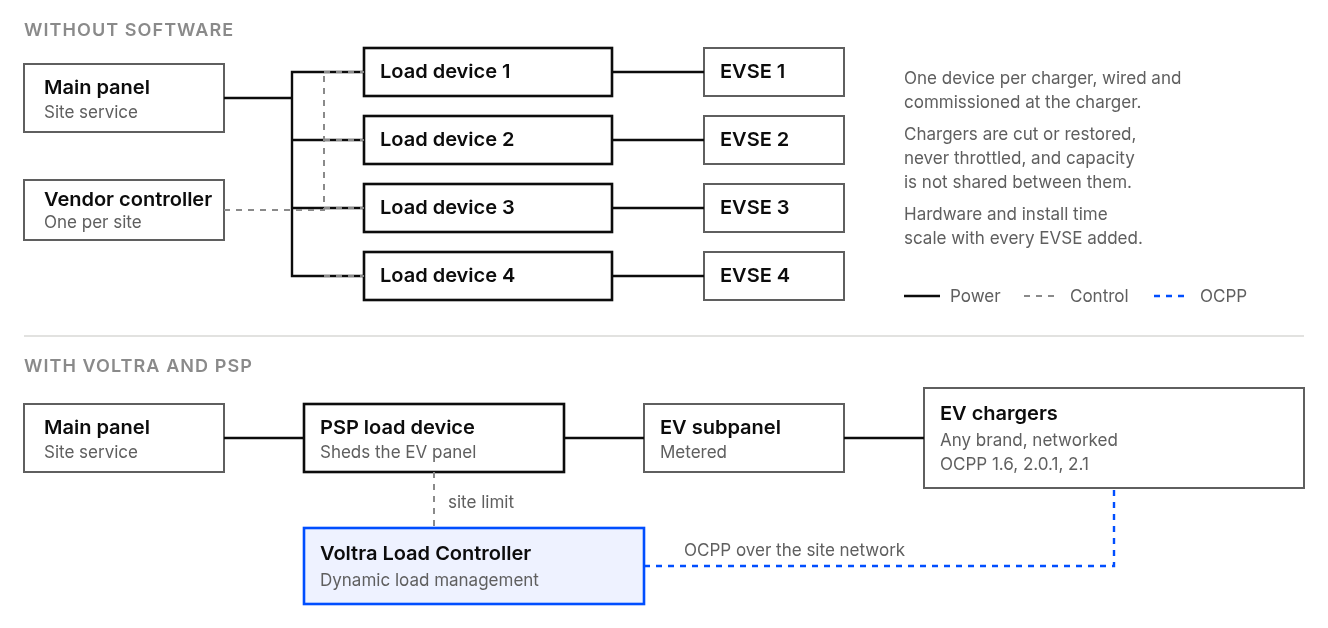
Without software, every charger gets its own load management device, and hardware and install time grow with every charger added. With Voltra and PSP, one PSP device and one Voltra Load Controller manage the whole subpanel.
Two limits, one rule
On site, the controller works with two numbers. The PSP device has a trip threshold, the point at which it sheds the EV panel. The Voltra Load Controller has an operating limit, set below that threshold. Charging is managed to stay under the operating limit, so under normal operation the trip point is never reached. If something unexpected pushes the feeder toward the trip point anyway, the PSP device does its job, and the software reports it.
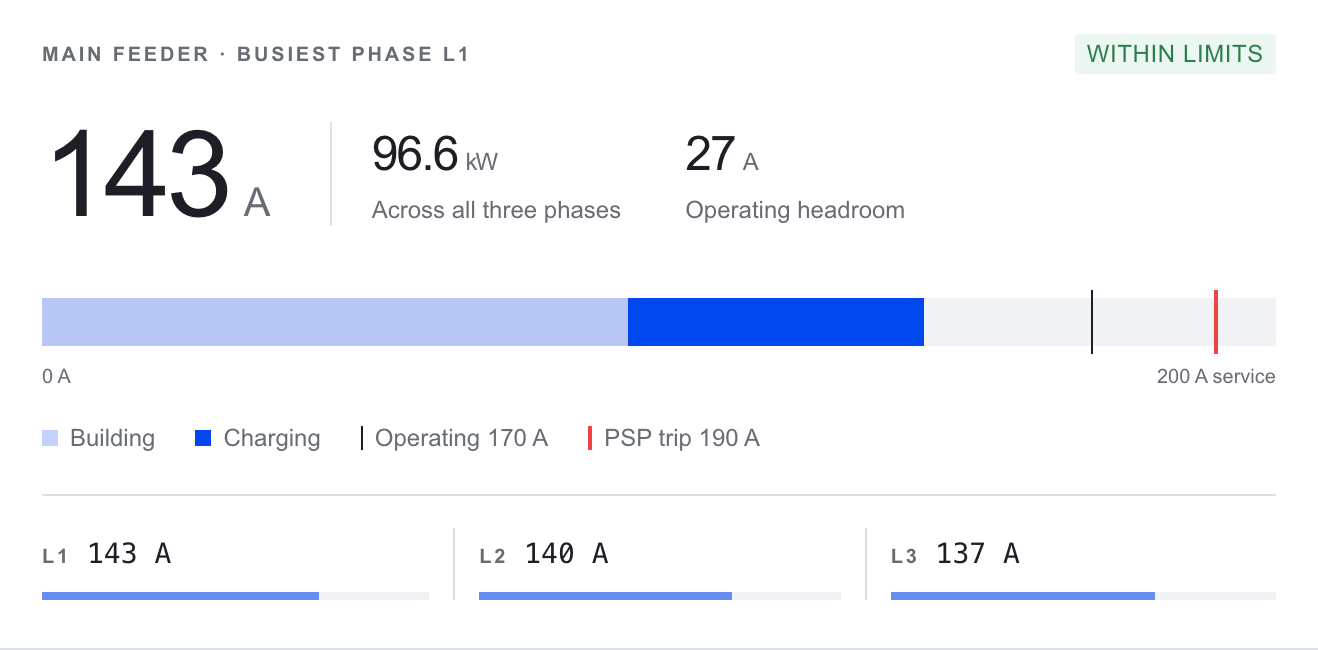
Inside the Voltra Load Controller: building load and charging load on one feeder, managed under an operating limit that sits below the PSP trip point, with the headroom shown live.
The result for a site owner is that chargers are rarely interrupted and the panel is always protected. The result for a contractor is that one listed PSP system and one controller cover a subpanel of chargers, instead of a device at every charger. With the larger controller, that is up to 100 chargers managed by two devices.
What we heard on the show floor
The response at NECA sorted itself into three groups. Contractors working with constrained service, especially the ones who had lived through a midstream scope change, liked the flexibility most: when the charger count or the panel allocation moves after the design is set, the controller adjusts to it without buying more hardware. A second group liked bringing remote monitoring into their toolkit, seeing the feeder, the limit, and every charger from anywhere instead of from the panel room. And plenty of people liked the basic idea on its own terms: fewer panels and fewer load shedding devices on the wall.
Three controllers
The Voltra Load Controller comes in three models, chosen by the number of chargers and where it mounts.
- VLC-10, for sites with up to 10 chargers. Compact, and mounts inside the PSP enclosure.
- VLC-100-SE, for sites with up to 100 chargers. Standalone with a wall adapter, so no electrician is needed for the controller itself.
- VLC-100, for sites with up to 100 chargers and more to come. DIN-rail mount with expansion modules for I/O, serial, analog, and wireless, and stackable for larger sites.
Every controller ships with a perpetual license for the load management software on the controller, a cellular SIM, commissioning support, over-the-air updates, and a 5 year warranty. All three connect over cellular, Ethernet, or Wi-Fi. The controllers work with PSP's LSC series load controllers over a two-wire connection and with RectorSeal RSH-VRM units over Wi-Fi, with PSP's next generation of load controllers connecting over the same two-wire bus.
It grows with the site
A Voltra Load Controller is a Voltra edge gateway with load control software on it. The same hardware connects the building's meters, HVAC, pumps, batteries, and solar, and each new capability switches on as a software upgrade on hardware already on the wall. Demand response, peak shaving, smart charging, building monitoring, and building control are all available on the same controller when a site is ready for them, backed by the Voltra Energy Cloud and the one live model of the site that Voltra Fabric keeps underneath.
So a site can start with the chargers and the panel it has today, and grow into energy management without a second box or a second platform.
What it does not do
A word about the boundary, because "software-managed" could be read as "software is in charge of safety." It is not. Safety load shedding stays in PSP's UL-listed hardware, with no software in the loop. The Voltra Load Controller reads the site's power data and manages charging over the network. Where it is useful for the software to ask a PSP controller to shed, for example on a site that mixes smart and basic chargers, that is a convenience, never the protection. The same rule applies when the controller takes on building loads: it reduces demand so the panel is less likely to trip, while the hard shed stays exactly where the inspector expects it.
How to get it
The Voltra Load Controller is offered to electrical contractors through PSP Products, alongside PSP's load management systems.
To scope a site, send us the panel schedule and service size, the charger makes and counts, the PSP model on site, and whether there is network coverage at the panel, and we will come back with the controller and the wiring that fit.
- Email hello@voltra.com
- PSP Products: pspproducts.com