The real-time coordination layer for energy infrastructure.
On every energy site, there's a job nobody owns.
The solar vendor minds the inverters, the charger vendor minds the chargers, the building system minds the building, and so on. Each does its job through its own portal, its own protocol, and its own quirks. The job of making the site itself work as one system belongs to no one.
Usually it belonged to someone at one point. An integrator wired it together at commissioning through weeks of bespoke configuration, a binder of documentation, and a diagram of how everything relates. Then a firmware update reset a default value, a battery got swapped, and a setting got "fixed" during an outage at 2 a.m. The site kept running but the versions of it started to diverge: the site in the binder, the site in each vendor's portal, and the site on the ground. Ask a question that crosses vendors, like if I curtail here, what trips? which battery backs that load? and you discover nobody can answer for the whole.
We heard this story from developers, integrators, and operators often enough to stop treating it as bad luck. The job nobody owns has a shape and four challenges:
Reach everything. Every vendor speaks a different protocol, so connecting a site isn't one integration: it's an open-ended pile of brittle, point-to-point ones that grows with every device you add.
Make it cooperate. Getting heterogeneous devices to share a circuit, honor a limit, or hand control back and forth means writing correct configuration to every device, each in its own dialect, all consistent with one another. Expert, bespoke, per-site labor that no two integrators do the same way.
Understand it. Even connected and working, raw data does not mean understanding. You can read values from every device, but not understand how they affect others and the system at large. There's no living, vendor-neutral picture of how anything relates.
And keep all of it true. Because none of the first three stays solved connections break on firmware revisions, configurations drift as defaults reset, and the picture goes stale the moment hardware changes.
The four jobs are coupled: do three and skip one, and you get a site that falls apart, not 75% of the solution. Plenty of good products sell a key to one of these, but nobody takes on the whole job. That's the role we built Fabric to own.
What is Fabric?
Voltra Fabric is the real-time coordination layer for physical infrastructure: the layer that keeps energy infrastructure connected, configured, understood, and true while it runs.
Lets follow a device through Fabric to see what that means.
Follow a charger through Fabric. A charger arrives on a site. In Fabric's library there's a profile for that model from that vendor: a single file that encodes how to speak to it, which quirks its firmware has, what data it exposes, what commands it accepts, and its state machine: every state the device can legally be in, and every legal way it moves between them. The profile is the clear picture of a device in language other systems can understand.
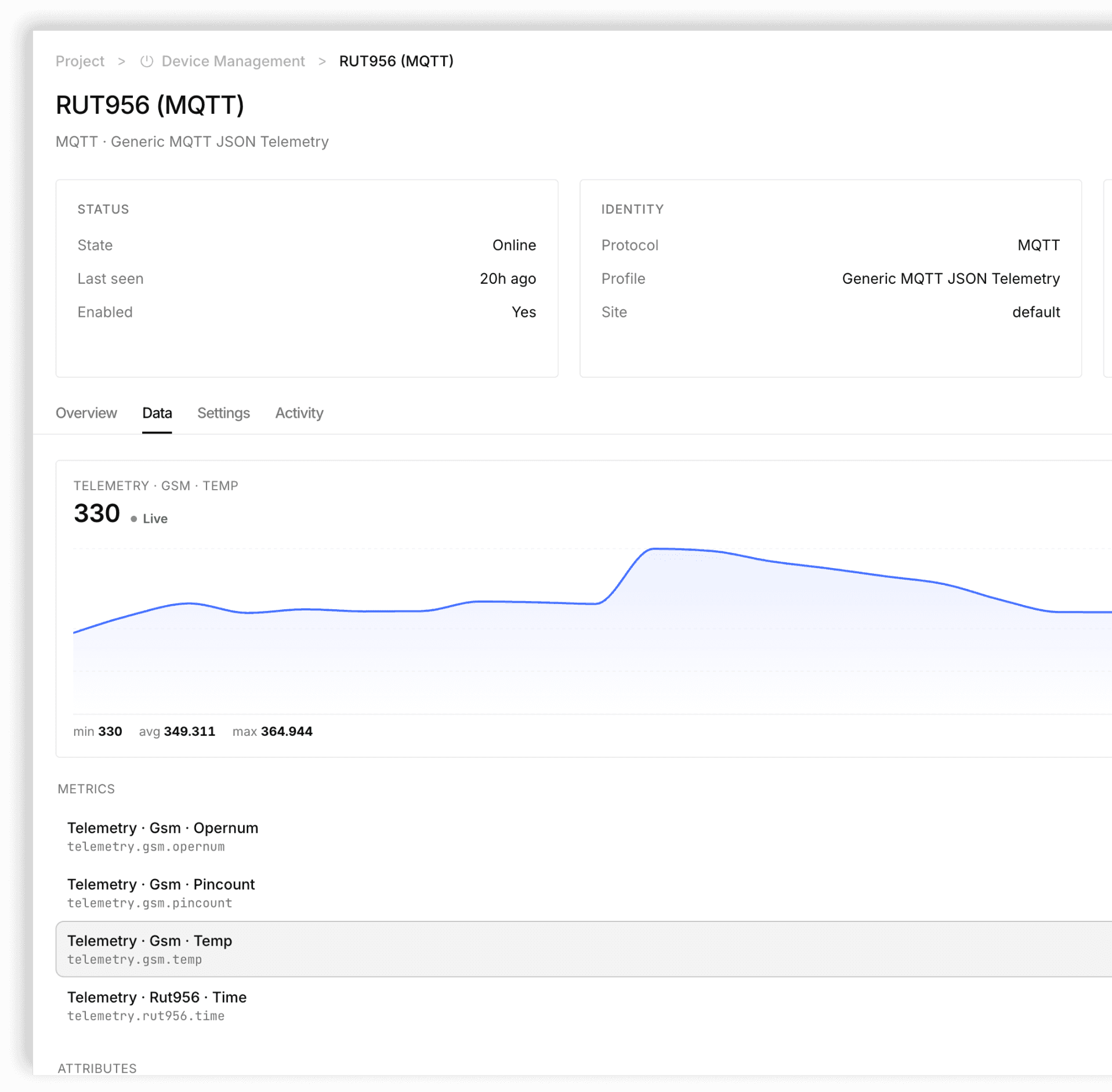
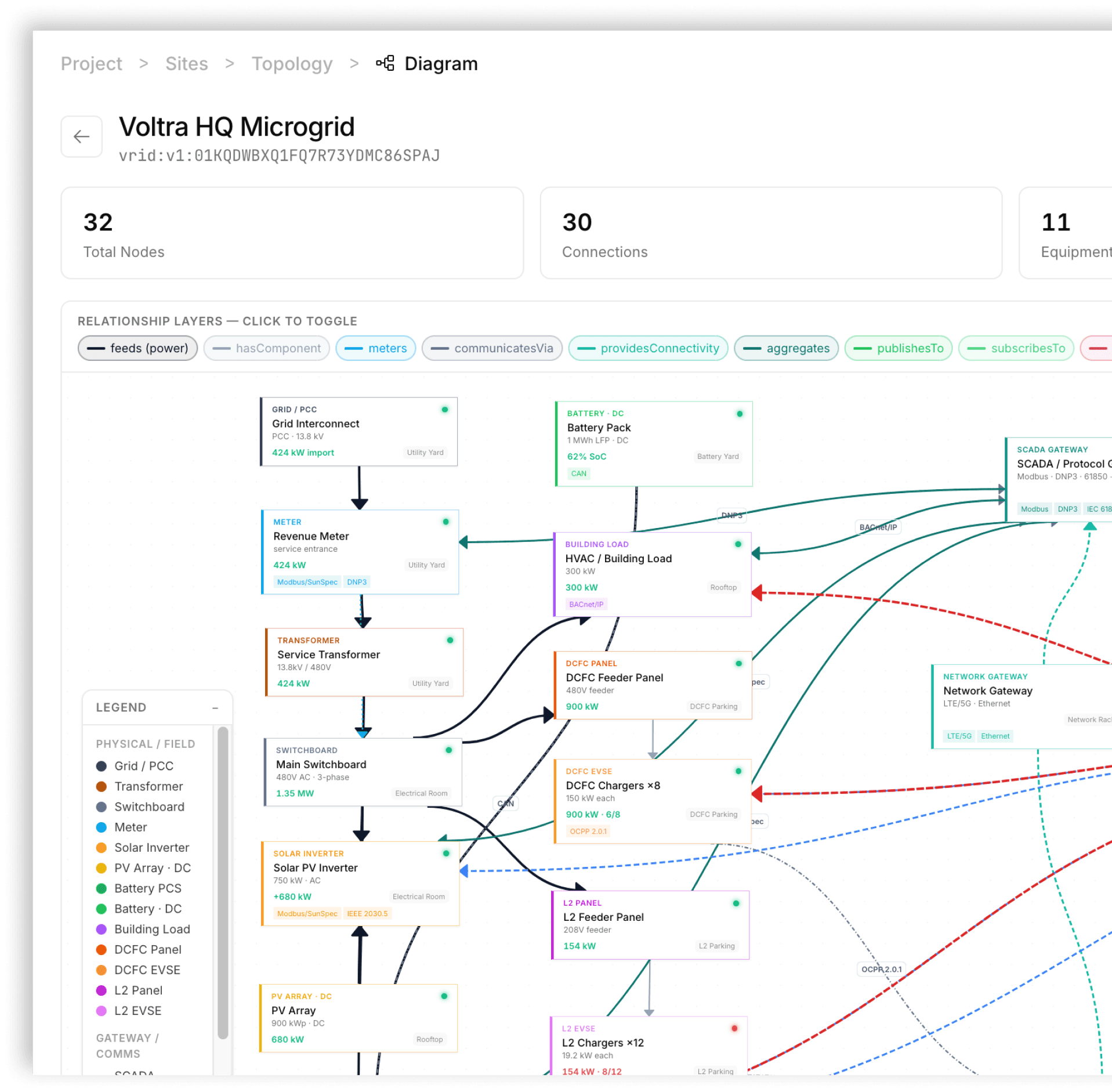
The moment it connects, the charger takes its place in the site's model: one governed, vendor-agnostic graph of every device, software system, and component - and, more importantly, how they all relate. What shares this circuit, what backs that load, what limits what, down to the modules and sensors inside each asset. Fabric goes far beyond what a protocol like OCPP carries because running a real site takes more than a charging session; it takes the meter reading, the inverter state, and the building load, all in context. Not simply a diagram in a binder: a live model, fed by the actual devices and real-time data.
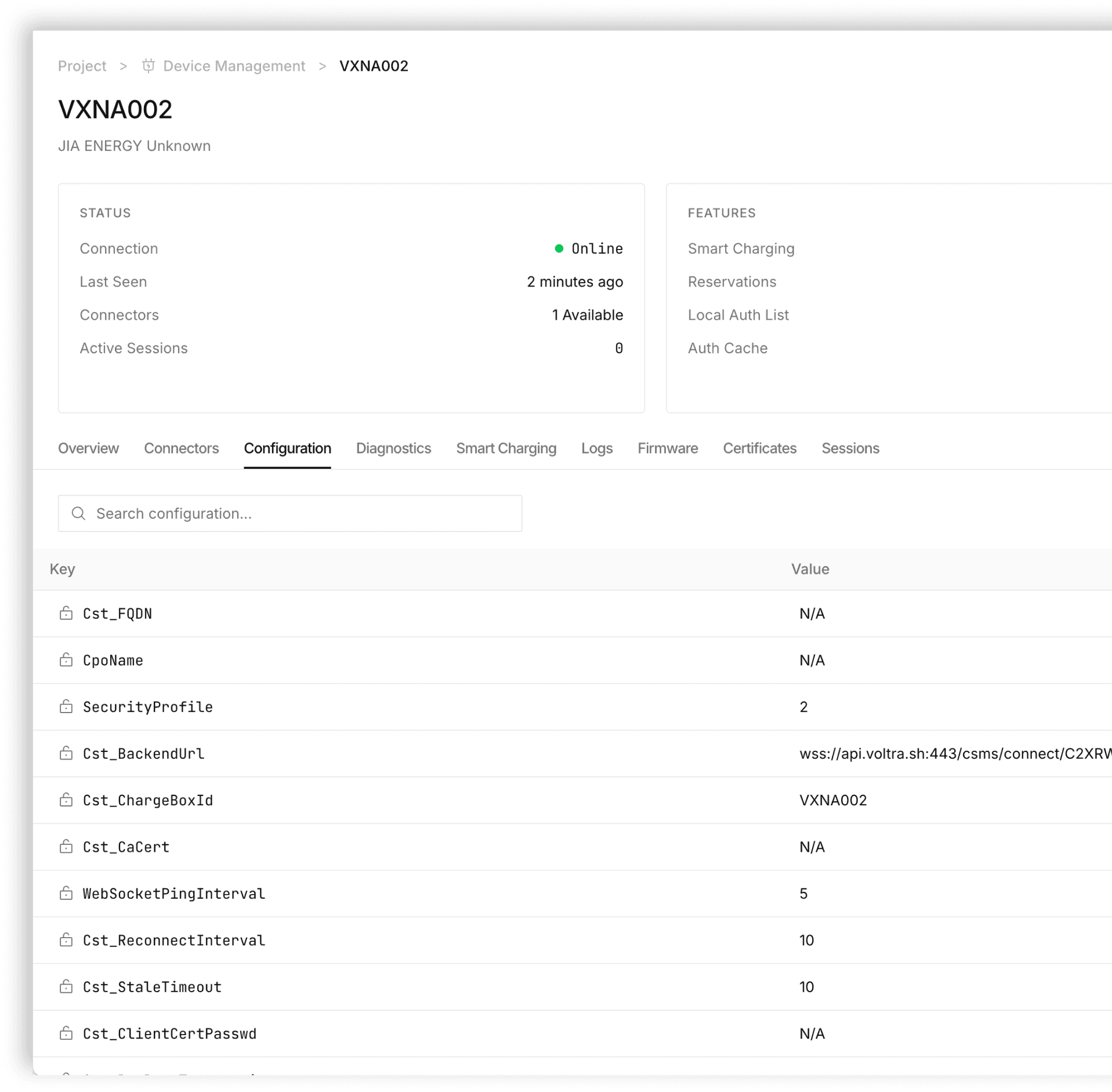
From that model, Fabric generates the configuration that makes the charger interact with everything around it, including the load-sharing, the limits, the signal endpoints, and writes it to the device, meaning you now know what "correctly configured" means for this site. The bespoke integration work becomes something the platform produces.
And from that moment on, the charger has a live process inside Fabric watching it, comparing what the device is doing against what its state machine says it should be doing, and what its configuration says it agreed to. A firmware update resets a default? Detected and corrected. Hardware swapped? The model updates instead of going stale. Every profile declares its own reconciliation policy, including which side is authoritative, how often to check, and what happens on a mismatch so drift gets caught as it happens, not discovered at the worst moment.
That's the whole product, seen through one device: connect, configure, model, maintain. Now multiply it by every inverter, meter, PLC, battery, and building system on the site and by the software around them. Fabric brings the vendor clouds and management systems you already run onto the same layer, including the local hardware that cloud-to-cloud tools never reach.
The benefits of Fabric
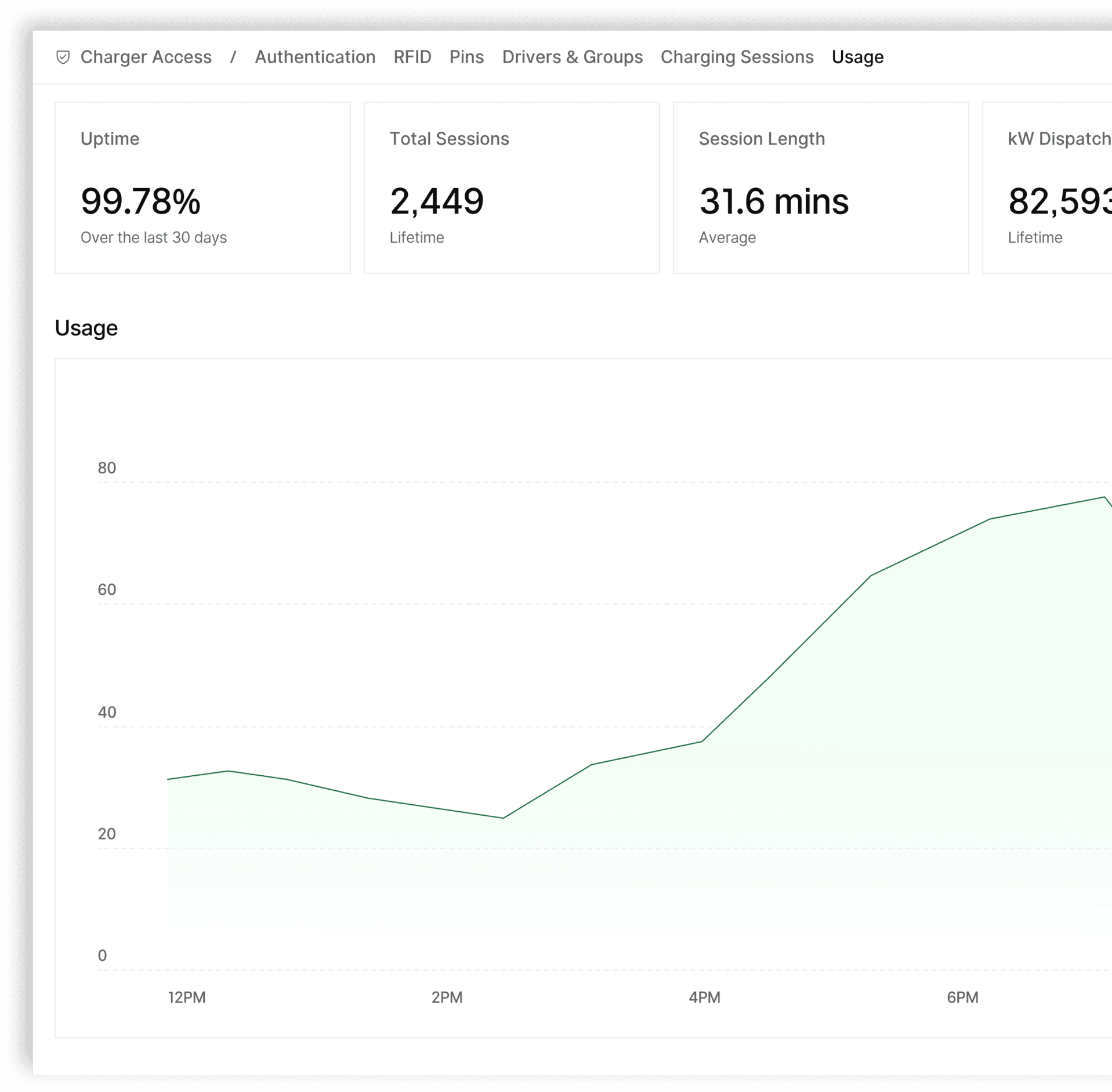
Because the whole site lives in one model, visibility stops being an integration project. Operators get clean custom dashboards across every vendor and device for usage, monitoring, and reporting, single-site and portfolio-wide with no stitching and no per-vendor portals.
And the site becomes something you can interrogate. The questions that used to take three portals and a spreadsheet now become which battery backs that load? what's actually drawing on this circuit right now? Answers become instant, because for the first time there's one place where the whole site is understood.
Coordination vs. orchestration
Coordination is what makes the site able to act as one: everything reachable, one live model, configuration consistent and kept true. Orchestration - deciding what the site does, and when - stays yours.
With the site coordinated, Fabric makes orchestrating it easy: the whole site is controllable and the model is queryable. But Fabric doesn't run the orchestration for you. You operate with the tools you already use, or with optional Voltra Energy Cloud services - usage-priced services for charge management, energy management, load management, payments, carbon credits, roaming, and telematics that you switch on only where your stack has gaps.
That separation is critical to a high-performance technology stack. Fabric coexists with the EMS, CPMS, and O&M software you already run - it connects your stack and exposes clean APIs to all of it. It doesn't rip anything out.
Three ways in
Fabric is designed to be flexible and reached however your team works:
- Console: the web app for operators: see and run the whole site from the browser.
- CLI: one login, every product from the terminal, with pipe-friendly JSON for scripts and CI.
- API, SDKs & MCP: everything generated from one OpenAPI contract per service, always in sync: a public REST API, official TypeScript, Java, and Python SDKs, and an MCP server that turns every API operation into a tool an AI agent can call.
Data and permissions are shared everywhere, meaning you can provision over the API and update in Console. All data is on the same surface: a model of your infrastructure that's governed, machine-readable, and current is exactly what site-level AI needs to reason and act safely in the physical world. Vantage, our AI layer over the entire platform, is in closed beta today.
Why this matters beyond your site
We can't build new grid infrastructure as fast as demand is arriving. The next decade gets carried by squeezing more out of what's already installed and that only works if real sites, the messy multi-hardware kind, can behave as coherent systems instead of collections of silos. We believe the grid gets modernized from the edge inward, one coordinated site at a time.
You don't have to buy the thesis to buy Fabric - it earns its keep on your site alone.
Available now
Fabric is available today at $199/month plus usage - and usage is unlimited through October 31, 2026. No bundles, no per seats, no forced minimums; Voltra Energy Cloud services are usage-based services you adopt (or drop) à la carte.